04 · Calisthenics skills
Whether you dream of a handstand, front lever, planche or elbow lever — I break difficult skills down into simple stages and guide you step by step.

What we train here
This is where you'll learn things no ordinary gym will show you. You develop not just strength, but also body control, balance and the skills that set true calisthenics apart.
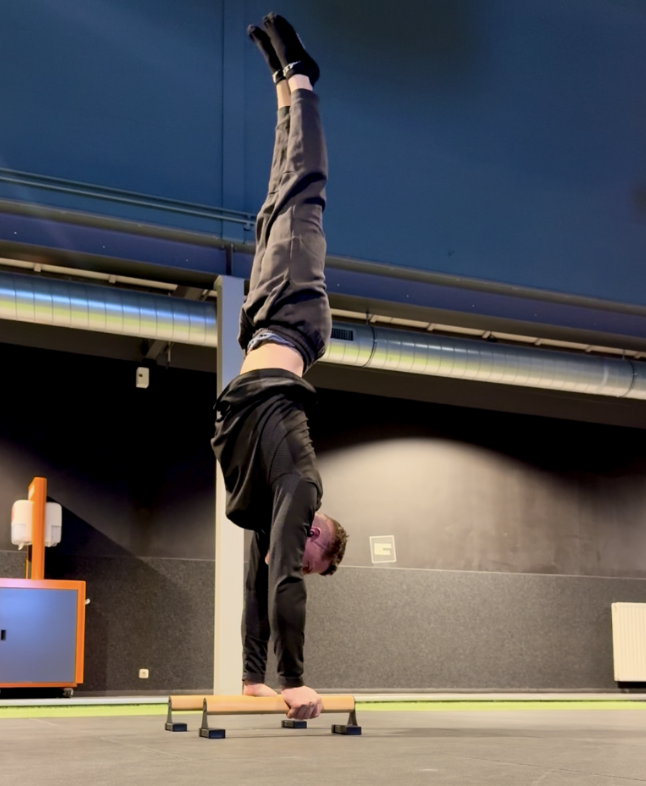
Standing on your hands with full control — the starting point for all acrobatics.
Handstand push-ups. Shoulder strength and stability in one movement.
A push-up with your body suspended horizontally. A signature display of pushing strength.
Holding your body horizontally beneath the bar. A classic display of back and core strength.
A horizontal position facing down. Shoulder mobility and rock-solid control.
Your body suspended horizontally above the ground on straight arms. The pinnacle of pushing strength.
Balancing with your body supported on your elbows. A dexterous and impressive skill.
Holding your body horizontally on a vertical pole. Full control of the peripheral muscles.
How we work
We start with an assessment: I check your shoulder, elbow and wrist mobility and your current body control. Without this, working on a handstand or planche ends in injury or months of standing still.
I break each skill down into progressions: tuck → advanced tuck → straddle → full. You work at the level you can perform cleanly today, and move on when your body is ready — not when your mind gets impatient.
I assist with movements where attempting them on your own is risky (front lever pull, planche lean, your first HSPU). I record your attempts, we review the footage together, and you get specific corrections — not generic advice from YouTube.
You train smart, without wasting months on random attempts. This cuts years off the path to your first handstand, front lever or planche.
Why this is more than the gym
Calisthenics isn't just about strength. It's about body control in every plane, balance, movement awareness and skills that truly set you apart in the gym or at the park. A barbell builds mass. A handstand, front lever or planche builds something you can't buy with a gym membership.
You can easily combine the training from individual lessons with any other plan — you do your own strength training, and once a week we work on a specific skill. Or we work through a full block focused on one skill (e.g. from zero to a front lever) over a few months.
FAQ
Not for every skill. We can start the handstand and elbow lever practically from scratch. The front lever, planche and HSPU require solid foundations — at least a few clean pull-ups and full-range push-ups. In the first lesson, I assess exactly where you're starting from.
Realistically, 8–16 lessons + your own practice between sessions. It depends on your mobility, shoulder strength and how many times a week you train on your own. A lesson is a catalyst, not magic — I show you exactly what to do at home or in the park.
Yes, that's a common combination. The programme guides your overall development, while the skills lessons single out a specific skill (e.g. the front lever) so we can work on it in greater detail.
On average, 6–18 months of consistent work, depending on your body weight and strength foundation. Most people achieve their first few seconds of an advanced tuck within 2–3 months.