Game Changer
GAME CHANGER #01: Don’t start learning pull-ups with a full pull-up
The most common beginner mistake: attempting a full pull-up before your body is ready for it. I show you what to do instead and why it works.
The pull-up is the exercise that trips up the most beginners. Not because it's too difficult — but because most people start with its hardest version.
What's the mistake?
You hang from the bar, try to pull yourself up, and can't. You repeat this every workout. Your body has nothing to build strength from because it isn't doing any productive work — just jerking around at the bottom of the movement.
The result is always the same: no progress, frustration, dwindling motivation, and quitting training after a few weeks. You're not the problem — the choice of exercise is.
Instead of struggling — use a regression
A regression uses the same movement mechanics, just in a version you can control. Three variations worth starting with:
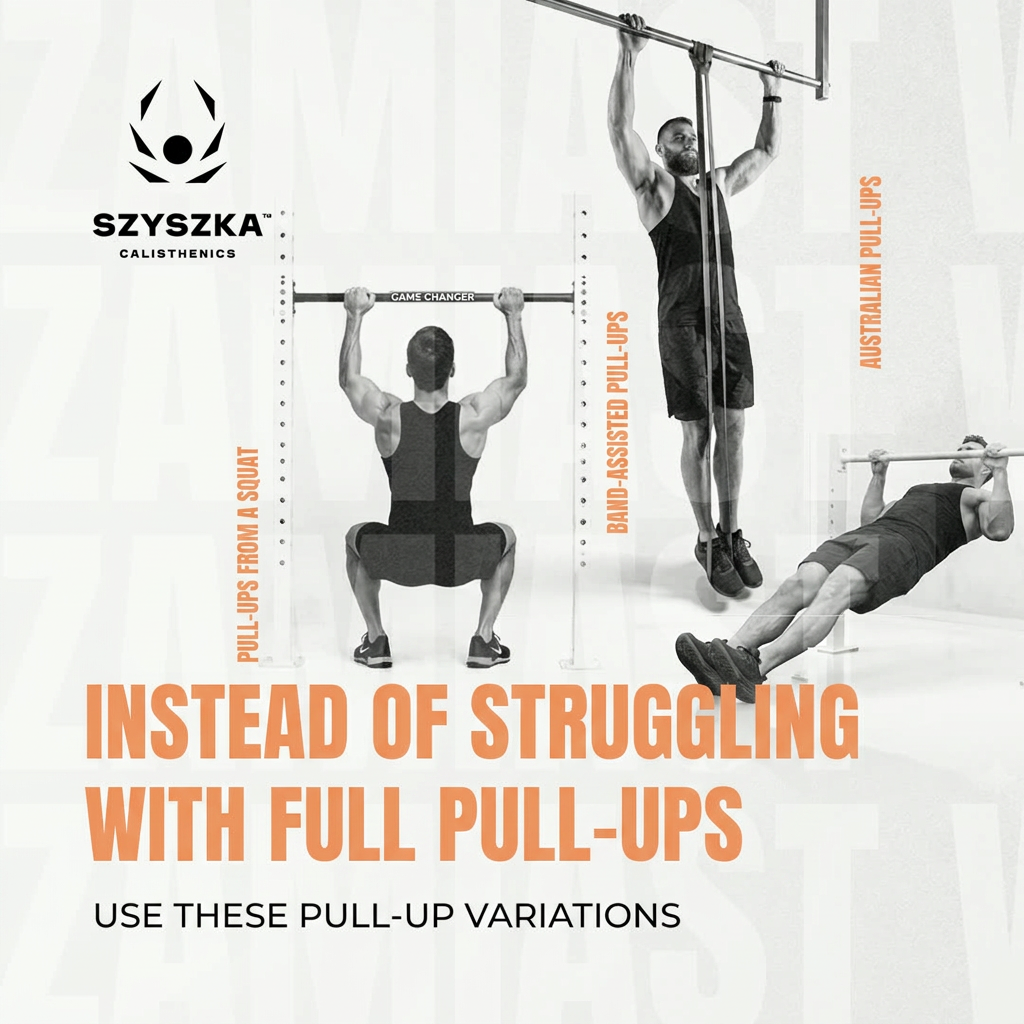
Pull-ups from a squat
the bar is set low, and your legs help just as much as needed. You control the load by how hard you push off.
Band-assisted
the band takes some of the load off in the hardest, bottom part of the movement and lets you complete the full range of motion. Use a lighter band as you progress.
Australian pull-ups
torso horizontal, bar at hip height. They teach you to retract your shoulder blades and build a foundation of back strength without battling your entire body weight.
The goal isn't to grind out one desperate rep. The goal is 3 sets of 8 controlled reps of a version you can master.
Why this works
You build strength at a level you're ready for
every set is real work, not a fight for survival.
You learn the movement pattern
retracting your shoulder blades, bracing your abs, and driving your elbows alongside your torso.
You prepare your muscles, joints, and nervous system for heavier loads instead of overloading your shoulders and elbows.
How to put this into practice
Choose one regression and stick with it for 4–6 weeks. Train your back 2–3 times a week, doing 3–4 sets of 6–10 reps, always keeping 1–2 reps in reserve. Once you can do 3 sets of 10 clean reps, reduce the assistance (a lighter band, a higher bar, a more horizontal torso).
Add an active hang: hang with straight arms and pull your shoulder blades down, for 3 sets of 15–20 seconds. It's the simplest way to build grip strength and shoulder girdle control.
If you’re unsure which regression to choose or how quickly to increase the difficulty — this is exactly the point where it’s worth working with a coach. Check out training for beginners or send me a message.
Next step
Book a free consultation
Tell me where you are now and what you want to achieve. Together, we’ll decide on the first step — with no obligation.